



















From Home Search to Client: A Better Follow-Up Plan

Generating a lead is only the beginning. The real opportunity comes from what you do next.
In this Expert Insights Live session, Ian Daniels and Todd Tramonte shared the follow-up system their team has used for more than a decade. It's worked through hot and slower markets, as well as everything in between, by giving agents a clear answer to two important questions:
Who should I contact today, and what should I say when they answer?
The system doesn't rely on one perfect script. It combines consistent outreach with useful resources and a CRM that helps agents stay on top of every opportunity.
Here's how to put it into practice.
Start by Changing How You See the Lead
Daniels and Tramonte stopped referring to people who register on their website as "buyer leads" years ago. Instead, they call them "home search leads".
That small language shift matters.
Someone browsing listings may be planning to buy, preparing to sell, researching for a family member, or simply trying to understand the market. A registration tells you what someone did. It does not tell you everything they need.
Labeling that person too early can narrow the conversation before it begins. Instead of assuming you know why they are searching, use your first conversation to find out.
Open With a Question That Gets Them Talking
The team’s opening script starts with something the lead has already done, such as searching for homes in a particular area.
Try this:
Hi, [name]. This is [agent] with [company]. I saw you were looking at homes in [area]. Are you focused only on [area], or are you open to nearby areas too?
It's an easy question to answer, and any response gives you somewhere useful to take the conversation.
If they're focused on one area, you can learn what's drawing them there. If they're flexible, you can help them compare nearby communities, schools, prices, or available homes.
The goal is not to get through a script as quickly as possible. It is to get the person talking, listen to what they tell you, and decide how you can help.
Build a Value Stack Before Asking for an Appointment
An appointment should not be the only thing you have to offer.
Daniels calls the other resources you can provide your “value stack.” It's a list of useful things you can offer based on what each person needs.
Your value stack might include things like:
-
An accurate list of homes that match their criteria
-
A saved search with new-listing alerts
-
A local market report
-
A home valuation or equity update
-
Neighborhood, school, or relocation resources
-
A helpful article, video, podcast episode, or calculator
-
Access to upcoming or private inventory when appropriate and compliant
You don't need to offer everything at once — Listen for the problem the person is trying to solve, then offer the resource that will help them solve it.
That gives them a reason to continue talking to you, even if they're not ready to meet just yet.
Keep the Conversation Moving
The team follows a simple pattern in conversations with home search leads:
-
Ask a useful question.
-
Listen to the answer.
-
Offer something relevant.
-
Ask for the appropriate next step.
If the person is interested but not ready for an appointment, offer another way to help.
That might be sending a market report, creating a more specific home search, sharing information about an area, or scheduling a quick call for a better time.
The next step should fit where the person is today. For one lead, that may be a buyer consultation. For another, it may be a five-minute call or a planning session for a move later in the year.
If someone asks you to stop contacting them or says they are not interested, respect that. But “I’m not sure yet” or “maybe later” does not have to end the relationship. It may simply mean they need more information before they feel comfortable and ready to move forward.
Follow Up Consistently With Non-Contacted Leads
The team uses a set schedule for leads they have not spoken to yet. This keeps new opportunities from being forgotten and prevents agents from spending all their time chasing one person.

This schedule is a general framework. Calls, texts, automated messages, and dialer use should follow applicable consent, opt-out, do-not-call, carrier, platform, and state or federal requirements.
Remember, this schedule applies only to people you have not yet contacted.
Once you speak with someone, your follow-up should change based on what they tell you. A person planning to move next month needs a different plan than someone who may move next year.
As always, make sure your calls, texts, emails, automations, and dialer use follow all applicable consent, opt-out, do-not-call, carrier, platform, state, and federal requirements.
Use Text to Set Up the Call
Unknown numbers are easy to ignore, especially with spam filters and call-screening tools becoming more common.
One adjustment that's worked well for Daniels is asking for a short phone appointment after someone responds to a text.
Try this:
Thanks for getting back to me. When would be a good time for a quick five-minute call? I’ll call you from this same number.
It's an easy question to answer, and no matter their response, it gives you somewhere useful to take the conversation.
This also gives the person control over the timing and lets them know which number to expect.
Instead of hoping they answer an unexpected call, you agree on a time to talk. That can lead to a more comfortable and productive conversation for both of you.
Know Who to Call First
When you have more leads than hours in the day, start with your newest non-contacted leads.
They have just recently visited your website and shared their information, so the search is still fresh in their mind. Reaching out quickly gives you the best chance of connecting while their interest is still active.
From there, work through the other groups in your follow-up schedule.
A dialer can help you move through older contacts more efficiently, but it should not replace the rest of your strategy. Using calls, texts, emails, saved searches, market reports, and relevant website activity together, can all help bring an opportunity back to life.
Don't Give Up on Older Leads
An old lead does not automatically become a dead lead just because time has passed.
They may have paused their plans, worked with someone else, or simply never connected with an agent in the first place.
If they begin looking at homes again, that renewed activity gives you a natural reason to reach out — and you don't need an elaborate explanation for why you're calling months later.
Try this:
Hi, [name]. This is [agent] with [company]. I saw you were looking at homes in [area] a while back. Are you still considering a move, or have you already found what you needed?
If they already moved, ask about how things went and leave the door open for future questions. Then, update your CRM so you're not continuing to follow up as though they're still actively searching.
If they're still considering a move, treat the renewed opportunity seriously and help them take the next appropriate step.
Let Your CRM Handle the Repeatable Work
A database with hundreds or thousands of leads cannot depend on memory.
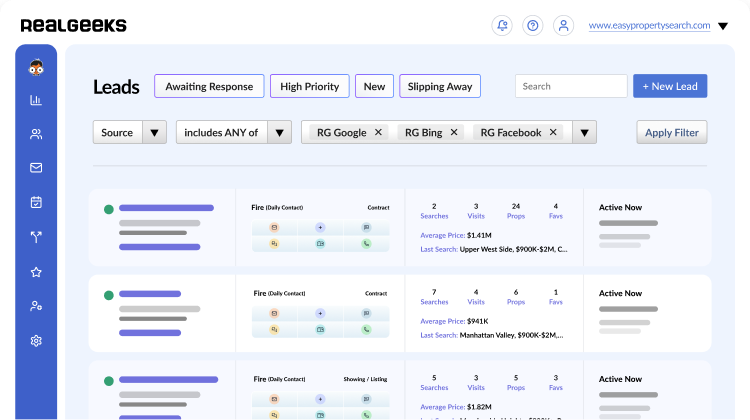
Real Geeks helps you keep the information and activity behind each opportunity in one place. You can see what a lead has been viewing on your website, create saved searches, send market reports, follow up through the CRM, and use workflows to stay in touch over time.
Automation keeps the repeatable parts of the system moving. Your job is to step in when a real conversation needs your attention, judgment, and local expertise.
For teams, a shared system also makes coaching easier. Team leaders can give agents a clear roadmap, see whether follow-up is happening, and help improve the conversations that are not leading to the next step.
Work the System Before You Change It
The strength of this follow-up system is not that any one script is especially complicated. It works because each part supports the others.
You have a clear schedule for who to contact. You have useful resources to offer. You know what to say when someone answers. Your CRM helps make sure the next opportunity does not disappear when the day gets busy.
Your exact words can and should sound like you. But before rewriting the entire system for every lead source, market, or personality, use the system consistently.
Pay attention to where conversations stall. Strengthen the value you can provide. Then you can adjust the language without losing the habits that make the system work.
Watch the Full Expert Insights Live Session
Watch Ian Daniels and Todd Tramonte walk through the complete system, including the scripts, call schedule, technology, and coaching principles behind it.
Want to join the next session live? Expert Insights Live sessions are free for Real Geeks clients. Talk to our team to see everything included and find out if Real Geeks is right for your business.